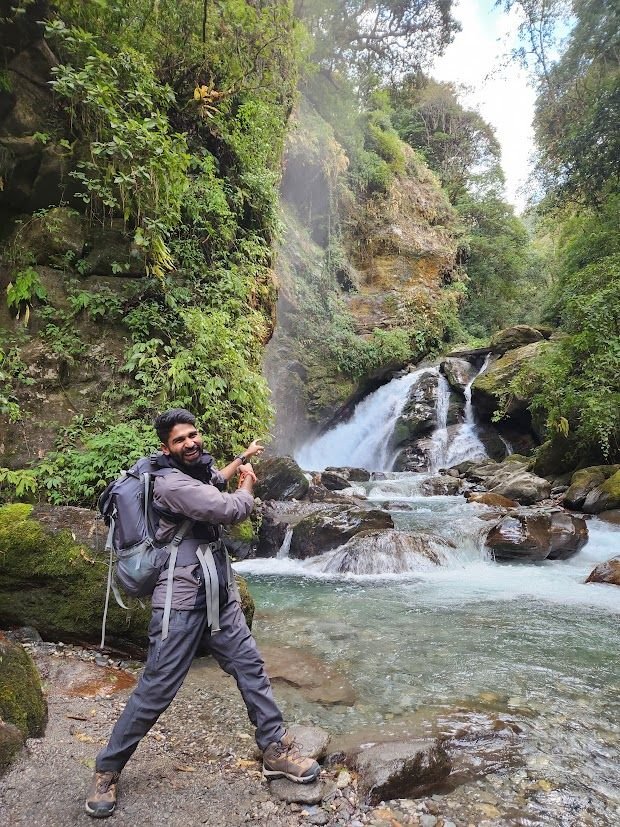
When I say Pashupati, I don’t simply mean a temple.
I mean a space that has repeatedly brought people and possibilities into my life. I have gone there restless and come back settled. I have gone there settled and come back with something to think about for a month. I have had conversations on those steps with people whose names I never learned and whose sentences I still carry.
It has become a space where I encounter people, ideas, silence, questions, and sometimes unexpected possibilities. That last one is not a small thing. A surprising number of the doors in my life opened somewhere in that vicinity, usually while I was not looking for a door.
Stillness and energy
My understanding of Shiva is deeply connected to my own exploration of life. What draws me is the balance held in one figure: stillness and energy, simplicity and power, creation and destruction. Not as opposites to be resolved, but as things that are true at once.
I find that useful, and not only spiritually. Most of the work I care about needs both. You cannot facilitate a room well without stillness, and you cannot move a group without energy. You cannot build something new without letting something old come apart.
I am wary of turning any of this into a neat lesson. It resists that. But it does keep pointing me back to one idea.
Anicca
Anicca. The impermanence of everything.
The idea resonates deeply with me, and it took me a long time to understand why. I think most people first meet impermanence as a loss. Things end. People leave. Whatever you built will not stay built. Read only that far and it is a sad idea.
But there is a second half, and the second half is the one I live in:
Everything changes. And perhaps the space created by that change is itself a possibility.
If nothing held still, nothing could be stuck either. The circumstance you are in is not permanent. Neither is the version of yourself who cannot yet do the thing. Neither is the state of your country, your family, your confidence, or your understanding of what you are for.
Change clears ground. What grows there is a separate question, and largely one for you.
Why I keep going back
I am not a scholar of any of this. I want to be honest about that. I am a person who walks, sits, watches, and occasionally understands something.
What I know is that I do my best thinking near moving water and among strangers, and that the practice of going somewhere without an agenda has produced more for me than most of my plans have.
Meditation does something similar, on a smaller scale, in a smaller room. Long walks do it too. The mechanism seems to be the same: stop steering for a while, and see what arrives.
Things change whether or not I approve. That used to feel like a problem. Now it mostly feels like an opening.